

Let’s Talk About Antelope
I have had the privilege of going on many safaris in Africa, and along the way, the most beautiful antelopes have been encountered. Each one carries its own personality, elegance, and survival story in the wild. Moreover, the more time that is spent watching them, the more fascinating their lives become.
Antelopes are not just pretty animals standing gracefully on the plains. Entire soap operas of survival, love stories, and dramatic escapes are constantly being played out in the African bush.
Therefore, it has always been felt that antelopes are the true stars of any African safari.
The mothers especially deserve some serious credit. Raising a tiny baby antelope in lion territory is not exactly a relaxing job. Meanwhile, predators are always lurking nearby, hoping that a distracted mother might present an easy snack.
So let’s dive into my top ten favourite antelopes that are often spotted while travelling across Africa.
Impala

Impala are often described as the ballet dancers of the African safari. Adults stand between 70 and 92 cm tall at the shoulder and carry a sleek reddish-brown coat. Moreover, the males are equipped with elegant S-shaped horns that can reach up to 92 cm long.
White markings decorate their bellies, chins, and tails, which gives them a very polished look. These antelopes were clearly designed with style in mind. Meanwhile, their favourite hobby seems to be showing off their incredible jumping skills.
Impala can leap over 3 metres high and nearly 10 metres forward. When danger approaches, an entire herd will suddenly bounce through the air like popcorn. Therefore, confusion is created for predators trying to choose their next meal.
Impalas love grassy plains and woodland areas. They feed on grasses, leaves, and shoots depending on the season. Additionally, large herds are always formed so that danger can be spotted quickly.
Huge numbers can be seen in places like Kruger National Park, the Okavango Delta, and Serengeti National Park.
Waterbuck
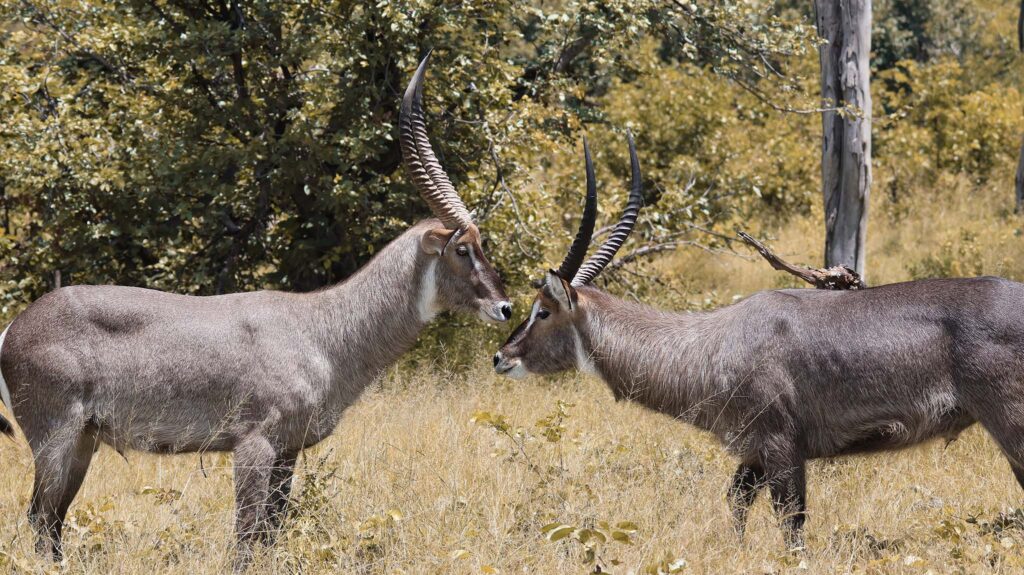
Waterbuck are the slightly scruffy-looking gentlemen of the antelope world. Adults stand between 120 and 136 cm tall at the shoulder and carry shaggy brown-grey coats. Moreover, their large, rounded ears make them look permanently surprised.
Males grow thick, ringed horns that curve backwards and upwards. These horns can reach nearly one metre long. Meanwhile, their famous white “toilet seat” marking around the rump always causes a giggle among safari guests.
Waterbuck are almost always found close to water. Rivers, lakes, and wetlands are their preferred hangouts. Therefore, sightings are common in Botswana, Zambia, and Tanzania.
They graze mostly on grasses and reeds near water sources. Lions, however, are not big fans of their strong scent. Consequently, waterbuck are sometimes lucky enough to escape being the main item on the predator menu.
Greater Kudu

If there were a beauty contest for antelope, the Greater Kudu would probably win every year. These elegant giants can reach 160 cm at the shoulder. Moreover, their twisted spiral horns are some of the most spectacular in Africa.
Male horns can grow up to 120 cm long and twist two and a half times. Honestly, they look like something designed by a very creative artist. Meanwhile, their grey-brown coats are decorated with graceful white stripes.
Kudu prefer woodlands and thick bush. They are shy animals and are often spotted standing perfectly still behind trees. Therefore, guides love pointing them out because guests usually walk straight past them.
Large numbers can be found in Namibia, South Africa, and Botswana.
Red Lechwe
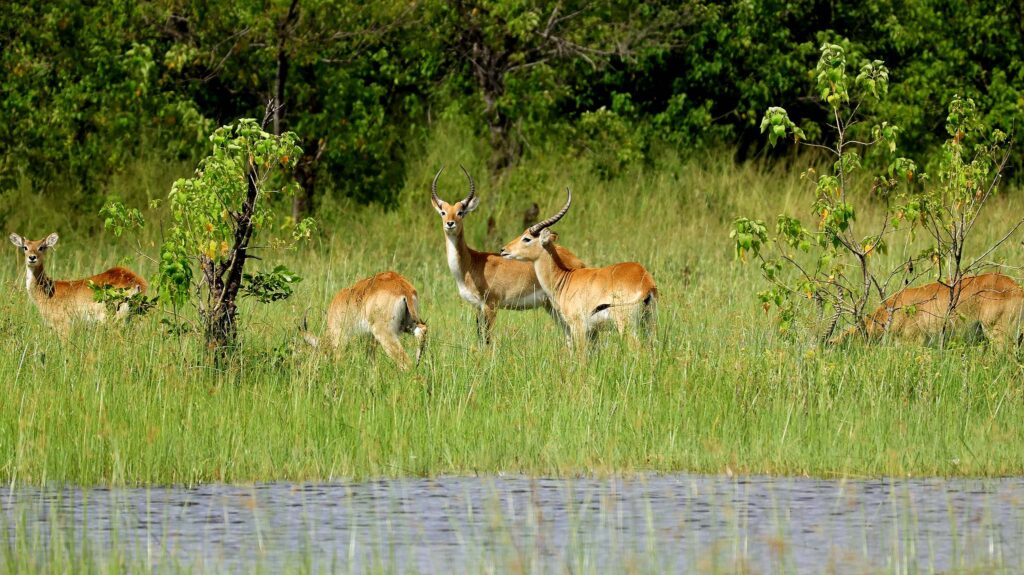
Red Lechwe are the dancers of the wetlands. These medium-sized antelopes thrive in flooded grasslands and marshy areas. Moreover, their waterproof coats allow them to move easily through shallow water.
Only the males grow beautiful lyre-shaped horns. These horns curve outward and slightly forward. Meanwhile, the females gather in large breeding herds that roam the floodplains.
Red Lechwe feed on aquatic plants and grasses. Their long legs help them run through water much faster than most predators. Therefore, lions often struggle to chase them through wetlands.
Huge populations can be found in northern Botswana, western Zambia, and Namibia’s Caprivi Strip.
Steenbok

Steenbok are tiny, adorable, and surprisingly tough. Adults stand only 45–60 cm tall at the shoulder. Moreover, their reddish-fawn coats help them blend beautifully into dry grasslands.
Male steenbok grow short, upright horns about 7–19 cm long. They look small but carry big personalities. Meanwhile, these little antelopes prefer to live alone rather than in herds.
They feed on leaves, roots, tubers, and grasses. Sharp hooves are even used to dig underground tunnels. Therefore, water is rarely needed because moisture is taken from their food.
Steenbok are commonly found in South Africa, Namibia, and Botswana.
Wildebeest

Wildebeest are the comedians of the savanna. Their shaggy beards, big noses, and cow-like horns create a wonderfully chaotic appearance. Moreover, they stand between 115 and 145 cm tall at the shoulder.
Both males and females carry curved horns. However, their most famous feature is their epic migration. Meanwhile, millions move across the Serengeti and Maasai Mara each year.
This migration is driven by rain and fresh grass. Herds travel hundreds of kilometres in search of food.
Therefore, dramatic river crossings filled with crocodiles become part of the adventure.
Sable Antelope

Sable in the Kalahari
Sable antelopes are often considered the royalty of the African plains. Adult males are jet-black, while females have chestnut coats. Moreover, both sexes wear impressive backward-curving horns.
Male horns can reach up to 165 cm long. These sweeping curves make them one of the most striking antelopes in Africa. Meanwhile, white facial markings create a dramatic contrast.
They prefer savannas and open woodlands. Grasses of specific heights are carefully selected for grazing. Therefore, sables are often found near water sources.
Nyala
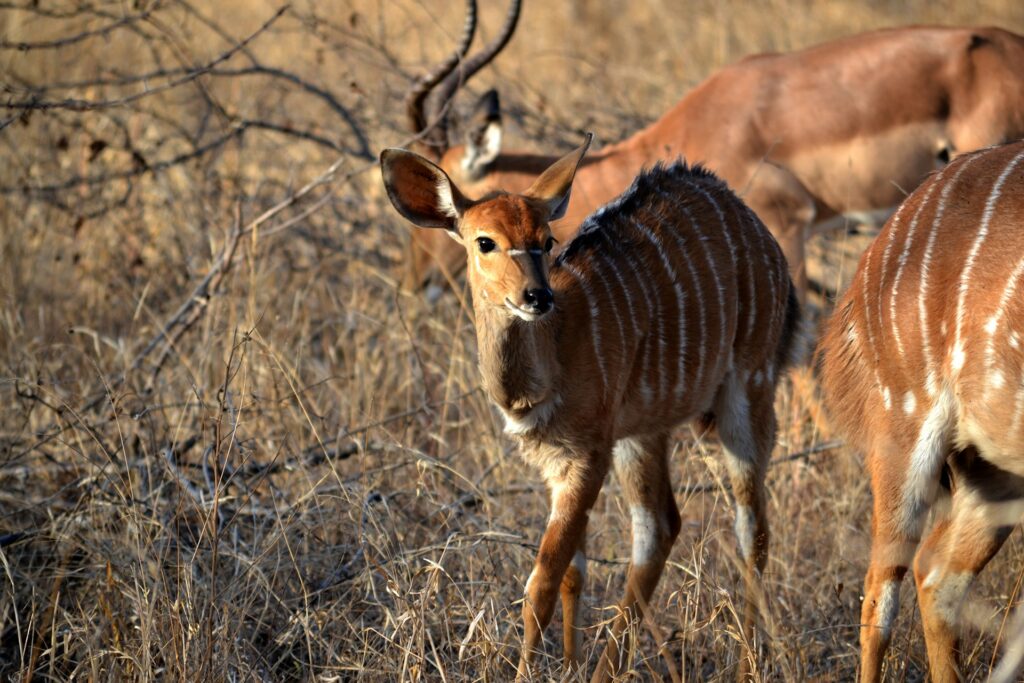
Nyala look like they stepped out of a fashion show. Females wear rusty red coats with white stripes. Moreover, males are slate grey with elegant spiral horns.
These antelopes have been around for nearly six million years. That makes them one of Africa’s oldest antelope species. Meanwhile, they love woodlands near fresh water.
Their diet includes grasses, leaves, fruits, and twigs. Sometimes, baboons are followed to collect dropped fruit. Therefore, a clever survival strategy is clearly being used.
Nyala can often be spotted in South Africa and Mozambique.
Tsessebe / Topi
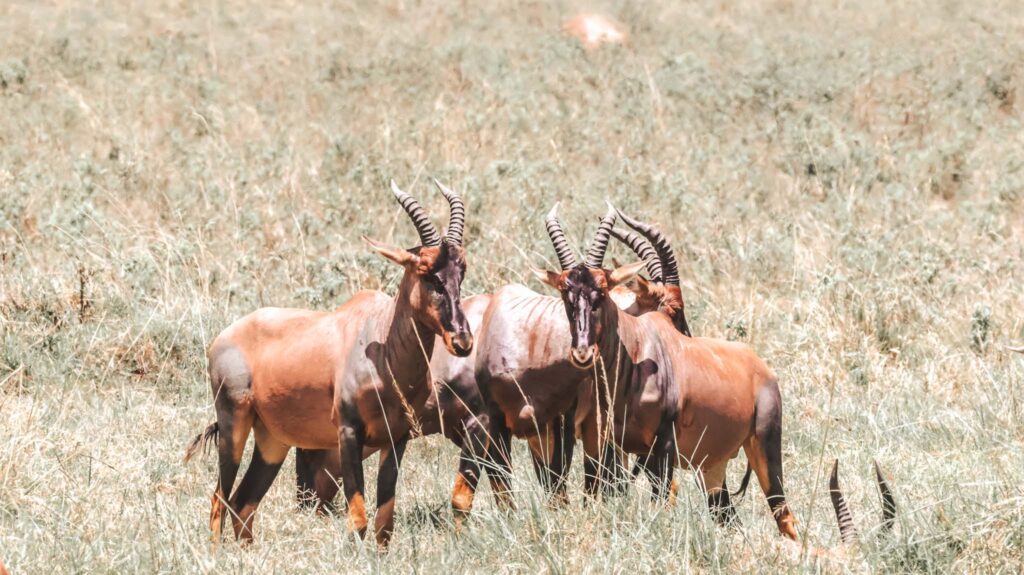
Tsessebe are built for speed. These sleek antelope can reach incredible running speeds across open plains. Moreover, their shiny coats change colour depending on the sunlight.
Their horns curve backward and create a sharp profile. They prefer open savannas where predators can be seen early. Meanwhile, their strong legs allow them to outrun most dangers.
Grass is their favourite meal. Large groups often graze together. Therefore, sightings are common in Botswana, Tanzania, and Kenya.
Bushbuck

Bushbuck are the shy introverts of the antelope family. Adults stand around 90 cm tall at the shoulder. Moreover, their coats carry beautiful white spots and stripes.
Unlike most antelopes, bushbuck prefer a solitary life. They quietly browse through thick vegetation alone. Meanwhile, grasses are rarely eaten.
Leaves, shrubs, and plants form their diet. Each animal keeps its own territory. Therefore, bushbuck are usually spotted near forests and dense bush.
They can be found throughout southern and eastern Africa.
Final Thoughts
Antelopes may look peaceful and elegant while grazing across the plains. Their lives, however, are filled with constant danger and incredible survival instincts. Moreover, every African safari would feel incomplete without them.
They shape the rhythm of the wild landscape. Their movements guide predators and influence entire ecosystems. Meanwhile, they also create endless entertainment for wildlife lovers.
Because where there are beautiful antelope, predators are never far away. Lions, lionesses, and leopards are always watching carefully.
Finally, the next chapter of the safari story is quietly being prepared for dinner time.